
How to Choose the Right Food Packaging Bag Material for Shelf Life and Product Safety
A practical guide for food brands on choosing flexible packaging materials by shelf life, barrier performance, sealing method, product sensitivity and food safety requirements.

Direct answer: The right food packaging bag material depends on the product’s oxygen sensitivity, moisture sensitivity, oil content, aroma retention needs, filling temperature and target shelf life. For most dry snacks, bakery items, coffee, frozen food and pet food, the best choice is a laminated flexible packaging structure rather than a single-layer film.
What problem does the packaging material need to solve?
Food packaging is not only a printed bag. It is a protection system. A good structure must protect the product from oxygen, water vapor, light, odor transfer, puncture and seal failure during storage and transport. Buyers should define the product risk first, then choose the film structure.
Key material selection criteria
| Product condition | Main risk | Common packaging direction |
|---|---|---|
| Roasted coffee | Oxygen, aroma loss, gas release | High-barrier laminate with valve and zipper |
| Dry snacks | Moisture, oil migration, crushing | Moisture-barrier laminate with strong seal layer |
| Bakery products | Moisture balance and display | Kraft paper laminate or clear window bag |
| Frozen food | Low-temperature cracking and seal failure | Cold-resistant film with strong puncture resistance |
| Powder or dry goods | Moisture and leakage | Multi-layer pouch with reliable zipper or heat seal |
Common flexible packaging materials
PET is often used as an outer printing layer because it provides stiffness, print clarity and dimensional stability. PE is commonly used as the inner sealing layer because it supports heat sealing and direct product contact. CPP can be used for heat resistance and good seal performance. Aluminum foil or metallized film improves oxygen, moisture and light barrier. Kraft paper adds a natural retail appearance but usually needs a laminated inner barrier layer for food use.
How should buyers specify shelf life?
A buyer should not ask only for a material name. The better question is: what shelf life must the package protect under normal storage? For example, a snack brand may need 6 to 12 months of crispness protection, while coffee may need oxygen and aroma protection plus a degassing valve. The packaging supplier can recommend a structure only after knowing the product type, weight, storage condition, filling process and expected shelf life.
Professional recommendation
For export food packaging, use a custom laminate selected around barrier performance and sealing reliability. A typical inquiry should include product type, filling weight, bag size, storage temperature, desired shelf life, printing requirements, zipper or valve needs, and whether the product is oily, frozen, powdery or sharp-edged.
Common purchasing mistakes
- Choosing packaging only by appearance and ignoring barrier requirements.
- Using a paper pouch without confirming the inner food-contact barrier layer.
- Requesting the cheapest film without testing seal strength and shelf life.
- Not telling the supplier whether the product is hot-filled, frozen or oily.
- Assuming one pouch structure can fit all food categories.
Buyer checklist before requesting a quote
- Product type and ingredients
- Target shelf life
- Net weight per bag
- Bag style: stand up pouch, flat bottom pouch, roll film, paper bag or ziplock bag
- Required features: zipper, valve, window, tear notch, hang hole or spout
- Storage and transport conditions
- Printing colors and order quantity
FAQ
What is the best material for food packaging bags?
There is no single best material. The best structure is usually a laminated film combination selected for oxygen barrier, moisture barrier, seal strength and product safety.
Do kraft paper food bags need an inner film?
Yes, most kraft paper food pouches need an inner laminated food-contact film to improve sealing, moisture resistance and product protection.
When should a brand use high-barrier packaging?
Use high-barrier packaging when the food is sensitive to oxygen, moisture, aroma loss, oil migration or long export storage.
Related packaging categories
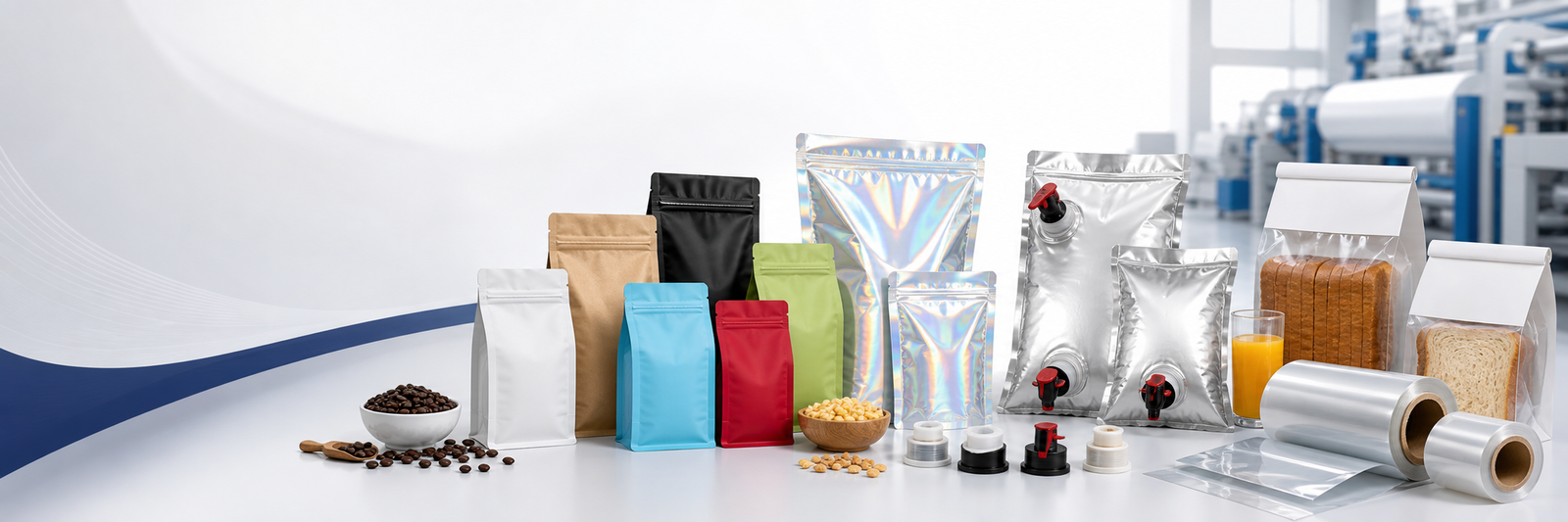
Relevant RH Packing categories include Food Packaging Bag, Stand Up Pouch, Kraft Paper Pouch and Packaging Roll Film.
Food Packaging Bag Material Guide
For buyers comparing food packaging bag material, the main factors are material structure, barrier performance, sealing method, printing requirements, MOQ, and storage conditions. RH Packing helps match these details to custom flexible packaging projects.
When should a buyer choose food packaging bag material?
Choose food packaging bag material when the product needs packaging that matches shelf life, filling process, display format, and transport requirements.
Can food packaging bag material be customized?
Yes. Common options include size, film structure, zipper, valve, window, finish, and printed brand design.